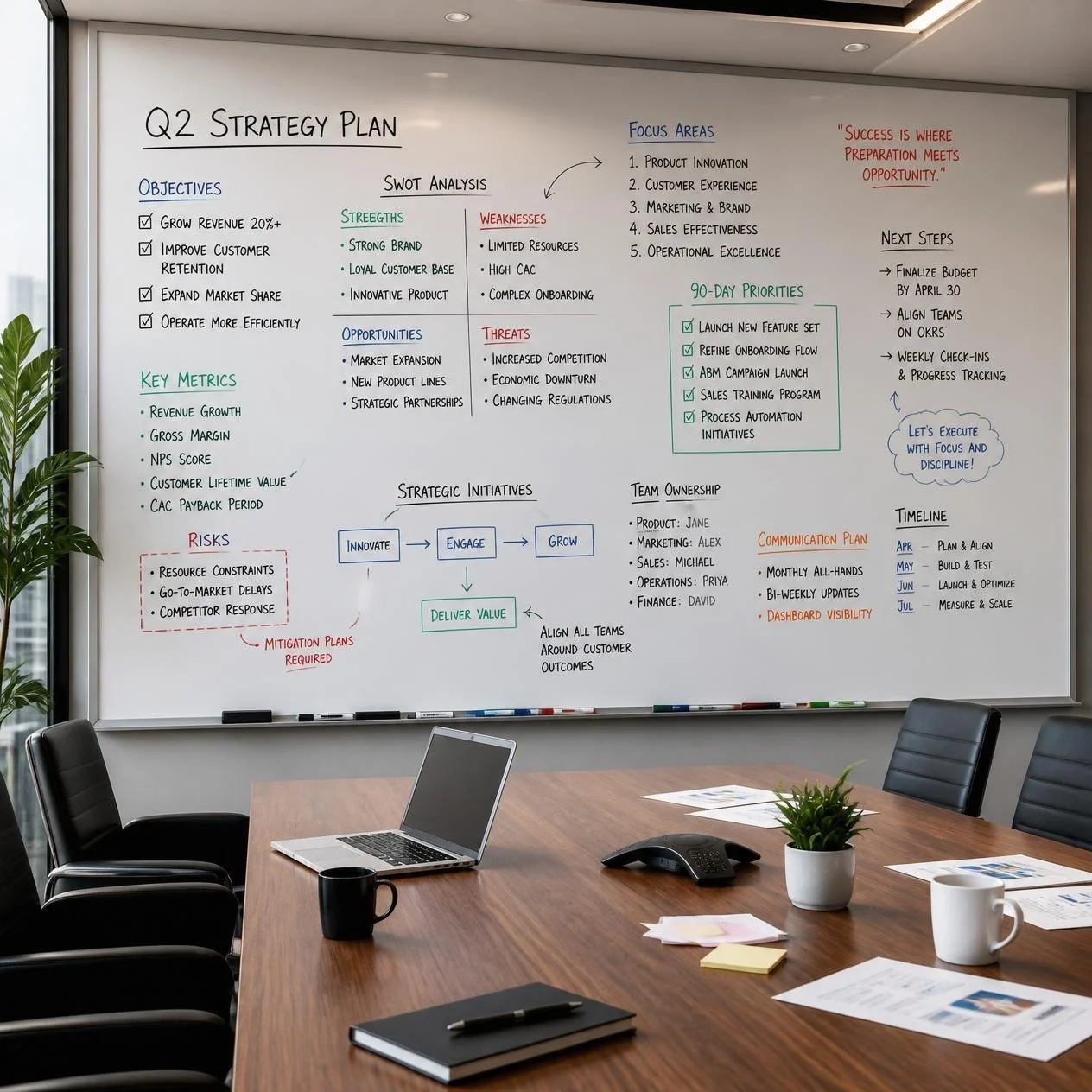
Every plan starts with hope.
A whiteboard full of good ideas. A leadership team that finally feels aligned. Someone shares it, stores it, and displays it along the main hallway. How many churches have a mission statement on the wall that is not being lived out down the hall?
And then, twelve months later, nobody can find it or even remembers it.
Not because the plan was bad. Not because the team didn't mean it. But because after the Monday staff meeting, the plan quietly stopped being a plan and became a document. Something you point to instead of something you follow.
This is one of the most common, and most preventable, traps in church leadership. Not a failure of vision. A failure of follow-through.
Why the Plan Dies
It was built for a weekend, not for a Tuesday. Retreats are good at producing clarity. They're bad at producing rhythm. A plan that only exists in the language of the retreat- five-year vision, sweeping mission language, aspirational pillars- has nothing for a staff member to do on Monday morning. Vision without a next action is just a nice paragraph.
It tried to fix everything at once. Most plans fail not because they aim too low, but because they aim at everything. Twelve priorities is not a strategic plan; it's a wish list. When everything is a priority, nothing is.
No one owns it. A plan with no name attached to each priority belongs to the whole church, which means it belongs to no one. Accountability isn't a spreadsheet column. It's a person whose job gets harder or easier depending on whether the thing gets done.
It was never built to be revisited. Most plans are written once and never reviewed. A plan that isn't built for regular evaluation isn't a plan. It's a snapshot of good intentions from a day that has already passed.
What Actually Makes a Plan Stick
They're narrow. Three to five strategic priorities, not twelve. Narrow enough that a staff member can actually name them from memory in September, not just in January.
They're broken into 90 days. Not five years. Not even twelve months. Ninety days is short enough to create urgency and long enough to produce something real. A church that can execute one good 90-day plan can execute four of them in a year. Four real wins will always outpace one five-year document nobody opens.
They have a name attached to every priority. Not a committee. A person. Someone whose review, whose next conversation with the pastor, depends on whether this moved.
They're built with an evaluation rhythm from day one. Not "we'll check in eventually." A specific date, a specific question, what did we measure, what moved, what didn't, built into the plan itself before it's ever printed.
The Real Issue Isn't Planning. It's Momentum.
Here's the deeper truth underneath all of this: a strategic plan isn't actually the goal. Momentum is the goal. The plan is just the vehicle.
A church can have a beautifully written plan and zero momentum. And a church with real momentum clear priorities, visible ownership, a short evaluation cycle will outperform a five-year strategic document every single time.
This is exactly why we built the second phase of Clarity to Impact around building momentum, not just building plans. It's not enough to define success and identify what's standing in the way. A church needs 3–5 strategic priorities that actually create movement, 90-day action plans that turn those priorities into next Tuesday's agenda, and a communication strategy that keeps the whole church — not just the leadership team moving in the same direction.
If your last strategic plan is sitting in a drawer somewhere, that's not a failure of vision. It's a sign the plan was never built to move.
Ready to move from a plan on paper to a church in motion? Build Groups can walk you through the Clarity to Impact process, starting with a diagnostic that shows exactly where your church stands today.